

Two great “Software for Catholics” initiatives and what may make them even more helpful... for everybody
Something relevant for every person, Catholic or not, who is forced to care about AI and digital tech. That is, pretty much EVERYBODY.
Preface
A few weeks ago I had a great conversation with Dr Tomislav Karačić of the London School of Economics, who had just lead a webinar titled “Developing Catholic AI: How to Balance Values in Design”. Most of the time we talked about “the world’s leading Catholic AI” I have just discussed in my previous post, and of Catholic Open Source. This is a “collaborative initiative empowering Catholic technologists to develop digital tools in service of the Church’s evangelizing mission” coordinated by the Texas-based Catholic Digital Commons Foundation (CDCF), whose mission is to coordinate community efforts for the common good and contributes to a shared digital patrimony for the Catholic Church.
The first part of this post summarizes what I dare say everybody, not just Catholics, should really know about the goals of Catholic OS and CDCF. The second part, that is primarily but not exclusively aimed at Catholic OS, CDCF and any other similar community, explains why I am in a special position to care about these issues and, hopefully, also to contribute.
Here are what I consider the most important points of the Catholic OS Manifesto (”M”) and CDCF Bylaws (”B”), rearranged and labeled by me for easier reference:
M-1: The Church’s social teaching offers a compelling vision for lifting up human dignity: a digital commons to serve the common good, strengthen families, democratize economic opportunity, inspire new evangelism, and empower human solidity.
M-2: Technological products are not neutral, for they create a framework which ends up conditioning lifestyles and shaping social possibilities.
M-3: We build against the reduction of the person to a data point or a mere instrument of production.
M-4: We cannot allow algorithms to limit or condition respect for human dignity, or to exclude... the hope that people are able to change.
M-5: [We also] commit to a human-centered pace of change... [and] advocate for a digital environment that respects the natural rhythms of human life and the “analog” requirements of a healthy soul... [because] “Leisure is a form of that stillness that is necessary preparation for accepting reality; only the person who is still can hear. -- Josef Pieper, Leisure, the Basis of Culture (1948)”
M-6: The Catholic Digital Commons is a “builder commons.”... Across countless repositories, there are tools built in the quiet of parish life - identity systems, liturgical calendars, and workflow engines- awaiting the nurture of a supportive community... Our mission is to aggregate, vet, and communalize these gifts. We transform scattered code into a durable architectural spine that outlasts any single volunteer, providing the Church with a discoverable and adoptable commons of open infrastructure.
M-7: [We want to preserve] each institution’s independent ability to use, contribute to, and govern its own data and tools.
M-8: We must learn to speak the language of technology to carry the Gospel into the digital age.
M-9: To guide our development, we adopt the full “algor-ethical” vision of the Rome Call for AI Ethics.
The Bylaws of CDCF state that the foundation is organized exclusively for charitable, educational, and religious purposes which include:
B-1: to coordinate, develop, steward, and disseminate open-source software, data repositories, technical standards, and digital platforms in service of the Catholic Church’s evangelizing mission
B-2: organization, structuring, preservation, and ethical use of ecclesiastical data [of all kinds]
B-3: Academic research coordination, data standards, academic advisory roles, joint initiatives, and educational programming.
B-4: fostering interdisciplinary exchange between theology, pastoral practice, and technology.
B-5: promote the ethical development and governance of digital technologies and artificial intelligence in accordance with Catholic social teaching.
Why I PERSONALLY care about all this stuff
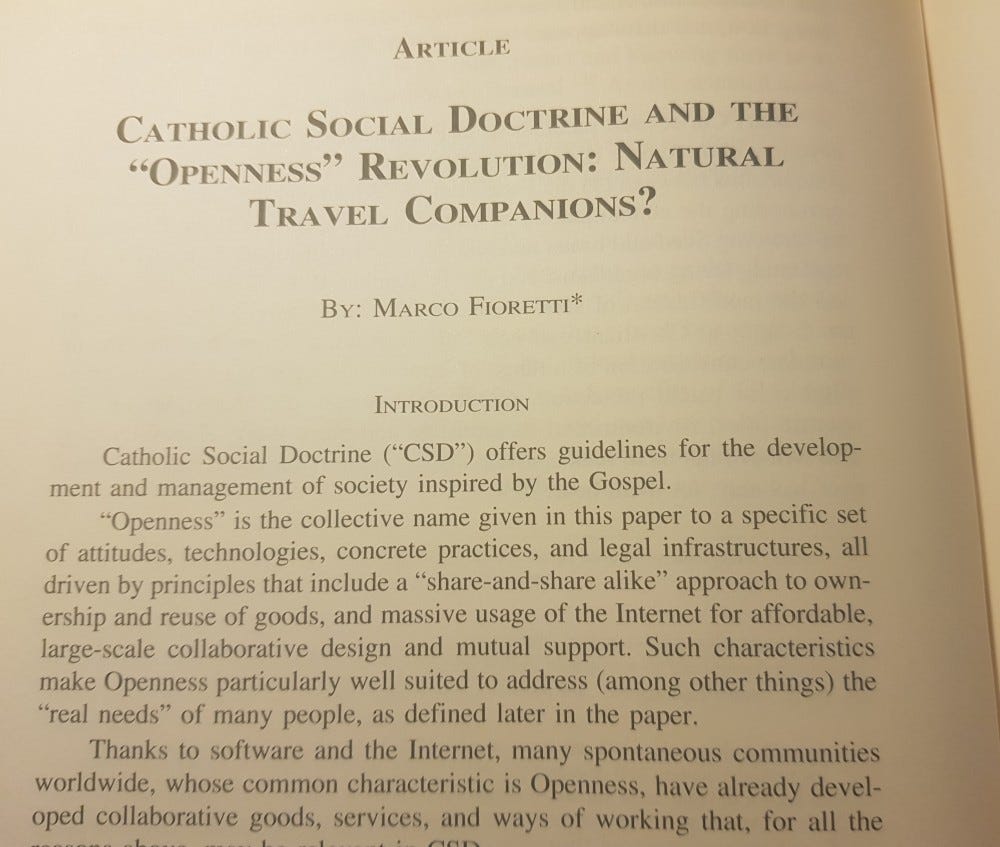
I care because I’m the guy who more than twenty years ago spelled out Free Software’s surprising sympathy with Catholic doctrine, then co-wrote the Elèutheros Manifesto for a Catholic Approach To Information Technology, followed up thirteen years ago with all the reasons why Catholic Social Doctrine and the Openness Revolution are Natural Travel Companions, and has been struggling to get reactions since then.
Backed by that work, I sincerely wish CatholicOS and CDCF every success because I think they are great. I mean, look again at the first five points of the Manifesto I selected above, just scraping “inspire new evangelism” if you’re not Catholic or religious in general: how could anybody of any political creed but sincerely wishing to make the world a better place disagree with them?
More specifically, I seriously think that anybody doing software should carefully read that manifesto and imbue any software they write with its principles, regardless of their religion or lack thereof. This said, I have three concerns about what I read - or sometimes did not read - in that Manifesto and Bylaws.
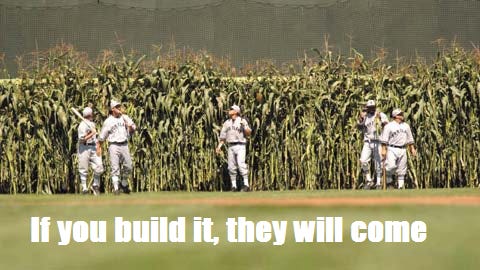
My first concern directly follows from the fact that building great Free/Open Source Software (FOSS) is not enough to make people use it. Not at all. “If you build it they will come” seldom works as in the Field of Dreams movie. Social inertia is always huge, especially about something like software that for 90% of the world population is still undistinguishable from black magic. In my experience, the hardest part of “making Catholics use FOSS” never was its quality. It was to make clergymen at any level get that they should care in the first place, instead of going “oh, this is about computers? Talk to my system administrator then”, or ignoring me altogether.
Even more important, the license of any software is much, much less important than what one creates with it, and how. In all my research and popularization work I routinely make this point with these three slogans:
“YOUR civil rights and the quality of YOUR life depend every year more on how software is used AROUND you”“
“You can build the perfect police state using only Free as in Freedom Software”
A Gnu/Linux user publishing documents in MS Office formats with LibreOffice makes more harm than a Windows user publishing documents in ODF formats with MS Office, because file formats are more important than software
So my first concern is seeing that education of ordinary users and calls for them to adopt free as in freedom formats and software aren’t the first goals of Catholic OS and CDCF. That is, I fear that they develop great products that won’t be adopted by enough people to make a difference.
The second concern is restriction of both stakeholders and of the “playing field”.
Shouldn’t the Catholic Overton Window for AI be wider?
I criticized the Rome Call for AI Ethics that guides Catholic OS and CDCF (point M-9 above) as soon as it appeared, but not because I think the Vatican should not make such calls. I did it because that Call seemed to me too restricted to Big Tech representatives and top catholic scholars with the best possible theological preparation and intentions, but not deep enough knowledge of the technologies involved.
That was in 2020. This month, I discovered that the Pontifical Gregorian University in Rome hosted last November a “Builders AI Forum” that, at least from the outside, appears to have the same limits. The motto of that forum was “Uniting to Build & Scale AI” and its goal to “foster a new interdisciplinary community of practice dedicated to supporting the development of AI products that serve the Church’s mission”. That’s why its sponsors included:
“a dynamic investment firm backing visionary founders committed to building with purpose”
the “For Schools” branch of a company develping “AI-driven Teacher Tools that guide educators toward efficiency and impact”, letting every student “embark on a personalized learning journey with an on-demand AI tutor”
With those premises, I should have not been surprised (and yet I was) to see among the participants... none other than the canadian branch of Palantir! Yes, Palantir, the company led by the very Peter “Better Jesus” Thiel who was here in Rome just a few days ago to lecture a few elects about the antichrist.
The bigger restriction I worry about here, however, isn’t about who is invited to these talks - only the powerful, not the meek who should inherit the Earth. It is the restriction of the agenda: “Build & Scale AI” and “supporting the development of AI products that serve the Church’s mission” seem to me too close to acritical acceptance of both AI into and for everything just because it’s AI, and of the “builders” primacy I already criticized around Magisterium AI.
Some proposals now
First, let me repeat it: I sincerely wish Catholics OS and CDCF every success, because what they want to do is necessary for the Common Good, regardless of religion. I am only concerned about two things, the first being that promoting development of the right software in the right way cannot be enough.
The other is the possibility that certain positions unwillingly end up favoring, instead of containing, forces that are only driven by profit or that confuse technology with religion. Remember point M-8 above? The one saying that Catholics must “learn to speak the language of technology to carry the Gospel into the digital age”? I am worried that as it is, that pointt can be exploited by those forces, instead of boldly being what surely is already in the heart of every Catholic OS and CDCF member, that is
“learn to speak the language of technology to make adoption and deployment of technology speak the language of the Gospel”.
Enough with concerns! Let me make some concrete proposals now. What about Catholics, Catholics grassroots communities, Catholic NGOs and Catholics institutions explicitly working to, in no particular order:
since “only the person who is still can hear [and accept reality]”, actively promote development and adoption, leading by example, of completely different social media, based on personal, permanent clouds, that encourage thinking by rejecting instantness, and are interoperable in the right way instead of pointless “data portability”
for the same reason, campaign as if there is no tomorrow to make everybody “get news online” in the only way that minimize stress, tracking and echo chambers, that is straight from the sources, the Open Source way
demand open formats everywhere, even before Free/Open Source Software, (for the record, that’s another thing I first proposed and taught twenty years ago, here (”Just Say No to OpenXML”) and here, and Germany did JUST last week! YAY!)
ask every government and local administration of the world the five questions I wish Pope Francis had asked to J. D. Vance
education!, that is: teach and popularize the general principles and technology-related concepts behind all these proposals in Catholic seminaries, schools, universities and dioceses worldwide
I and other Catholics first tried to propose a Catholic approach to Information Technology with the Eleutheros Project twenty years ago. I have never stopped to fight these fights in the widest ways I could, as everybody can see from my main publications, Foss Force column, main blog and its current Substack proxy.
I will continue to do it, but I would really like to work more, much more on everything I’ve mentioned in this post. If anybody is interested, just email mfioretti@nexaima.net.